Continuing the Conversation:
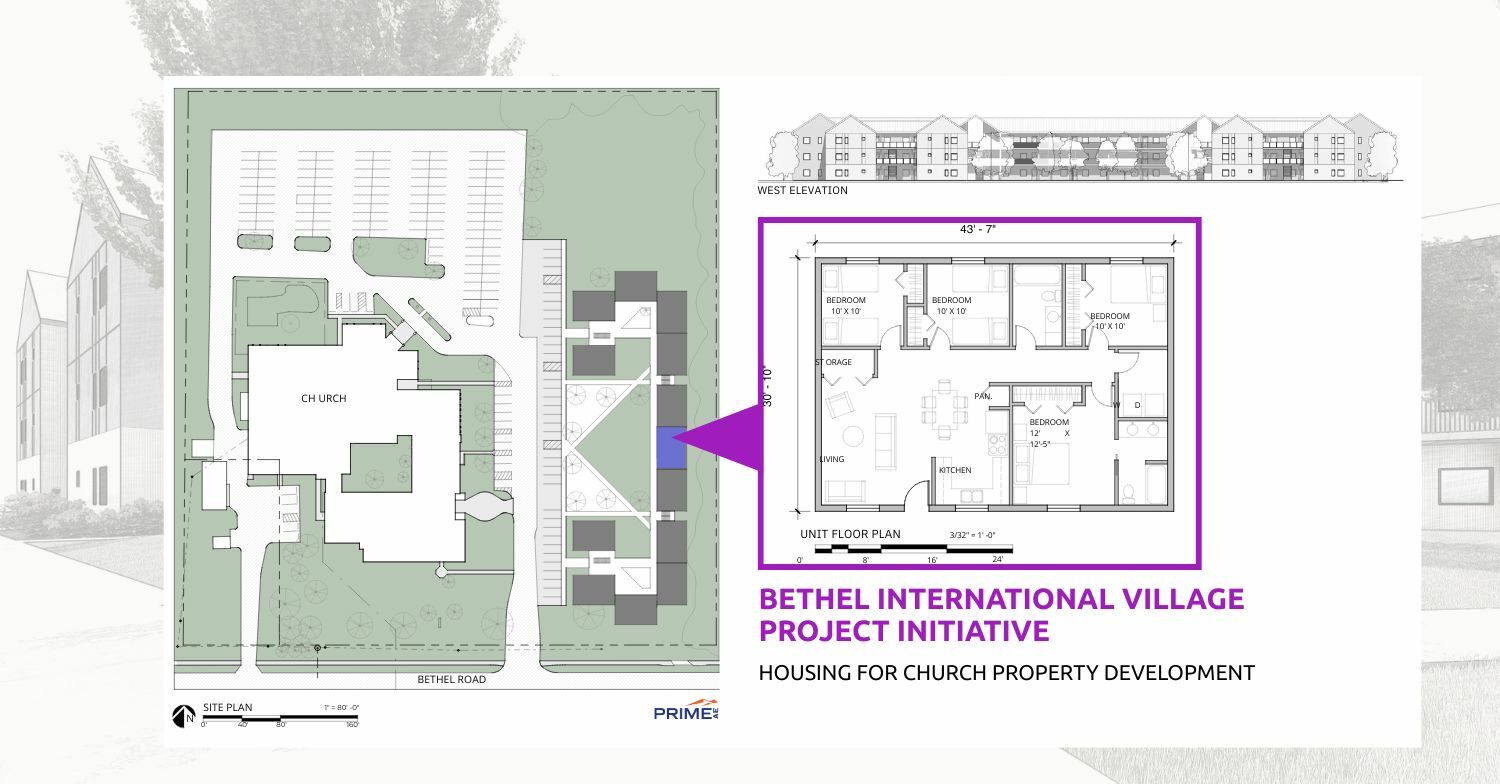
Bethel International UMC continues to prayerfully explore the possibility of developing affordable housing on church property as part of our mission to love and serve our neighbors.
At this time, we have not yet received an update from the City of Columbus regarding pre-development funding, and we remain in a holding pattern. The delay may be connected to the city’s recently enacted YIGBY legislation, which supports faith communities seeking to use their property for affordable housing. While we wait for more information, we want to keep the congregation informed, answer questions as clearly as possible, and continue this conversation with transparency and care. The Q&A below will be updated as new questions arise and as new developments occur.
Affordable Housing Initiative Q&A:
Housing is one of the most critical factors for stable, flourishing families and communities.
Building affordable housing is a holy work!
- It reflects God’s character, who is a provider and protector of the vulnerable.
- It restores justice by helping to correct systems that squeeze people out of communities
- It fosters community by providing a stable foundation for individuals and families to thrive.
Central Ohio has a shortage of 53,000 affordable housing units, and that gap is increasing by 3,000 units per year. This shortage forces low-income residents to compete for housing with higher-income residents, often leaving them in substandard dwellings or without shelter at all.
In addition to BIUMC’s devotion of time and energy to this project, the church’s financial investment will be the leasing of the land.
The preliminary estimated cost is $17 million:
- $1 million in equity (land) from the church
- $1 million from the developer
- $5 million grant from the city of Columbus
- $10 million in financing
In the proposal, the church is to receive $50,000 per year for leasing the land. Other sources of income to the church may be identified. If the guaranteed income to the church is insufficient, the project will not proceed.
The goal is to protect the church from all financial liability.
A Limited Liability Corporation (LLC) has been created to own and manage the project, and the church retains an attorney to protect its interests. The members of the LLC will be the church and the developer, with the developer assuming the risk and consequently receiving potentially higher income.
The LLC, not the church, will be responsible for repaying the loan.
As of April 2026, the project is on hold.
The church applied for a $5 million grant from the City of Columbus in July 2025.
Before making a decision on that application, the city needs additional pre-development work (environmental studies, engineering studies, more detailed architectural work, etc.) The city is currently considering paying $250,000 to complete this pre-development work. If the city grants this money, we anticipate moving ahead to obtain the information necessary to make an informed decision about the project.
In weighing whether or not to cover these pre-development costs, the city is aware that BIUMC has not made a decision about the project itself.
BIUMC has not incurred any expenses as of April 2026. All expenses have been paid by grants and pro-bono work by potential partners.
- BIUMC’s consultant is Rev. John Edgar, founder of the United Methodist Church for All People and Community Development for All People, which has developed more than $150 million in affordable housing in Central Ohio.
- The attorney representing the church’s interest is Adam Saad of Saad and Saad LLP. He has created an LLC, which could eventually be the owner and manager of the project. All legal fees thus far have been covered by a grant.
- Craig VanderVeen, local representative of the national architecture and engineering firm Prime AE, created the initial proposal. The architect's work thus far has been done free of charge as a business development effort.
- Michael Kelly of the Kelly Companies has agreed in principle to develop and manage the project.
We have signed a contract for legal representation with Saad and Saad, LLP.
As of April 2026, we have not signed any additional contracts, any agreements to build housing or accept city funding, nor has BIUMC committed any money to the project.
The property will be managed by a professional management company selected collaboratively by the church and the developer.
The property must be managed and tenants chosen in compliance with the lender, the city, or legal requirements related to affordable housing.
The church would not have direct control over selecting tenants.
Affordable housing rents for this project are likely to be based on 80% of the median income for the area, based on family size.
Currently, the monthly rent would be approximately $2,500.
We have preliminary architectural renderings and a site plan, which are posted in the church lobbies.
These plans indicate 3-story buildings with 39 4-bedroom apartments. The square footage is approximately 1,400 sq ft.
More detailed architectural plans and drawings will be needed as part of the pre-development work. Plans could change significantly depending on input from the city, lender, and outcome of pre-development site work.
Initial drawings reflect green space of approximately ½ acre at the north side of the units and some in the interior courtyard area of the project. Parking for the project is located on the west side of the project (east of the church).
The project would diminish but not eliminate the church’s green space, and based on the preliminary drawings, reduce current parking spaces from 250 to 136. Creation of additional parking space on the north and west of the church building could be included in the project.
We don’t know at this time. If we receive approval of the pre-development funds, pre-development work might begin in 2026.
Anything of this magnitude will involve changes.
The project will bring new opportunities as well as challenges. This process will help BIUMC evaluate our values, vision, and ministries to determine how best to use our property and strengths to serve our neighbors and community.

-
Bethel International UMC