30 Years of Contemporary Worship

30 Years of Contemporary Worship
Looking back on Bethel's contemporary service
By Mark Fox, Director of Music
Introduction
Almost exactly one year ago was the 30th anniversary of the founding of our Contemporary Service and, though we didn’t do anything to “celebrate” that occasion, I don’t think it’s too late to share some perspectives. Our first true contemporary worship service was on September 17, 1995. That morning, we sang “Shine, Jesus, Shine”, “That’s What Faith Must Be”, “Awesome God”, and “Great Is the Lord” with a small band consisting of piano, bass, and drum set. To my knowledge, it was the first true contemporary service of any United Methodist church in central Ohio (though many soon followed). What began as a lightly attended service of about 50 folks grew to an average of about 180 by 2001 and remains well-attended today. Although many mainline churches now offer a contemporary service, I believe ours is unique. I’ll explore some of those reasons, some history, and some critiques of Bethel’s story of contemporary worship.
Part 1: Why a Revolution?
It was called the “contemporary service revolution” and led to what was termed the “worship wars”. But why was this combative imagery and a “revolution” necessary? Following WWII, most Christians attended mainline denominational churches. The feel was rather formal and the music consisted of hymns and choir anthems—mostly classical or traditional in style. But the world was changing. Think about the period from 1965-1975. Music went from “Ticket to Ride” and “Hang on Sloopy” to “Bohemian Rhapsody” and “Kashmir”. Cinema went from “The Sound of Music” to “One Flew Over the Cuckoo’s Nest”. Broadway went from “Man of La Mancha” to “A Chorus Line”. Trust in government eroded due to the Pentagon Papers and Watergate. Technology was moving faster than at any time in history to that point. The world was changing, but the mainline church largely was not.
All this change—plus a huge number of teenagers due to the baby boom—led to something called the “generation gap”. I think the most obvious example of this is the fact that I have attended rock concerts with my children on a number of occasions. But it is absolutely unimaginable that I would have gone to a rock concert with my parents! I was listening to Styx and Rush while they were listening to Perry Como and Pat Boone. To say the least, our artistic tastes were worlds apart! And little at church was evolving. There were some teen musicals like “Celebrate Life” that we could experience occasionally, but the music/art/drama on Sunday mornings remained entrenched. I remember trying to add a drum set and bass guitar to the piano on an anthem for our teen choir in 1979 and you would have thought I was asking to have a live animal sacrifice during the service!
By the late 1970s/early 1980s, some non-denominational churches like Vineyard and Maranatha were starting to use guitars and drums to accompany their “soft rock” worship songs. They began to be very popular with young people and drew away many of the “rock” musicians from mainline congregations. This also coincided with the rise of the contemporary Christian music industry. Bands like The Second Chapter of Acts and Petra, and artists like Amy Grant and Michael W. Smith were selling albums, getting radio airplay, and performing at Christian festivals like Ichthus and Cornerstone. By the 1990s, the exodus from mainline to non-denominational churches was too great to ignore. Mainline churches began to attempt to offer contemporary services, but they were late to the game. Most mainline church musicians read music, but few knew how to perform a song from a recording using just a lead sheet. They didn’t want to let go of hymns, but there are musical reasons that hymns don’t work well in a “rock band” setting. The United Methodist Church tried to be helpful with music supplements like “The Faith We Sing”, but it mostly consisted of dated Vineyard/Maranatha songs.
Furthermore, since mainline churches were keeping their traditional services while trying to start contemporary services, they were spreading their musical resources thin. More staff, equipment, and volunteers were required. Budgets were strained and resistance remained. Many churches felt a great sense of conflict during this time. To be honest, Bethel handled this transitional time better than many—if not most—mainline congregations. We’ll look at Bethel’s experience next.
Part 2: Bethel’s Experience with Contemporary Worship
It began with an exodus, and then a choir. A group of us came to Bethel in 1993 following a church split. We were looking for a new home for our youth musical drama group, Sonshine, and Bethel’s pastor was eager to bring it in to help jumpstart the fledgling youth program. Besides Karol and I, Rodney and Keri Newcomb, Sarah DeWees, Lori Gillfillan, and many others started attending Bethel. Karol and I immediately joined the choir, but realized the three morning services had only one choir. I suggested that we could start a second choir to help fill in the other services and the pastor readily agreed. Using mostly refugees from the other church split, the Agape Singers were born, singing choral music that was somewhat more contemporary than the traditional Chancel Choir.
In the summer of 1995, I suggested turning a lightly attended 9:45 service (held during the Sunday School hour) into a contemporary service, with the Agape Singers as the song leaders. Bethel member Bob Piascik agreed to play bass and a former student of mine, Mickey Courtright, agreed to play drums. The beauty of this transition was that, unlike most churches, Bethel didn’t need to “rob Peter to pay Paul”. No musical resources from the main traditional service needed to be sacrificed. Just a few months later, the music director, Donna Peterson, moved away and I suddenly found myself directing both choirs. I stepped away from the traditional service in 2008, but then returned in 2015 following my retirement from teaching.
At this point I should mention Denise Alexander. Denise grew up at Bethel and her mother, Marlene, was the organist. Denise was already singing some light contemporary music at Bethel in “special music” slots (Amy Grant, Twila Paris, etc.) I was immediately drawn to her amazing voice and humble spirit and she quickly joined the Agape Singers. Between Denise, Keri Newcomb, Karol Fox, Rodney Newcomb, Michael DeWees, and others, there were few popular solo songs that we could not share with our congregation. The band also quickly grew with the addition of Joe Cotton (guitar), Mark King (piano), Betsy Fox (keyboards), Scott Geyer (drums) and Rick Brown (percussion). If I heard a new song on a Monday, I could write a lead sheet on Tuesday, email it to the band on Wednesday, and we could perform it on Sunday morning! That was a unique situation!
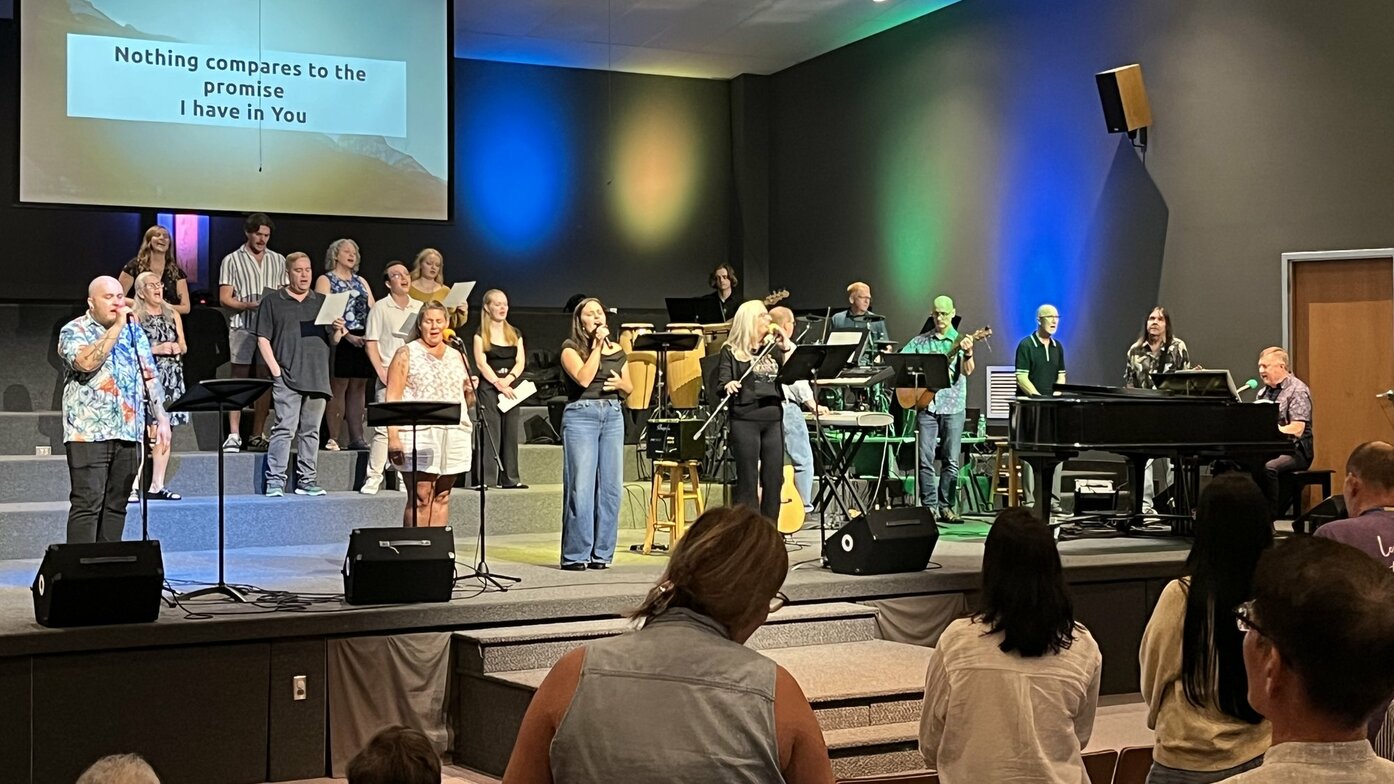
And yet the focus was not on the “special music” slots, but rather on congregational singing led by a “praise team” of a small choir. Whereas many churches put a single “star” singer in front of a band to lead worship, our approach was more of a group effort. Praise songs were arranged in 3-part harmony with the melody in the practical range of the congregation. The Agape Singers never felt like they were there to perform, but, rather, that they were there to lead the singing of others. Of course they still sang anthems a couple times a month as well.
The major challenge was finding music for congregational singing. The worship music genre was in its infancy and there were very few resources. We found most of the available Vineyard/Maranatha songs to be too, well, sappy and “folky”. The Agape Singers would always let me know it when they thought a piece was “cheesy”. I remember that I read in Worship Leader Magazine that “As the Deer” was the #1 worship song in American churches. I thought maybe I was missing something, so we sang it for a week or two. It only took that long for the singers to threaten mutiny and we immediately dropped it. There would be no “cheese" in our contemporary service! Soon, the world of worship music exploded and became more available. For more information, please read my previous blog, “Should We Sing the Songs of Hillsong?”
For years, my measuring stick was this: If the guys I played in a rock band with in high school came to my church, would they find a particular song to be “cool” or “lame”. And what makes a song cool? Well, like some other things in life, it’s not easily defined. You know it when you see (or hear) it. A few years later, it wasn’t my high school friends, but rather the children of the original Agape Singers who became the yardstick. The older I got, the more I asked them for their input. This continues to this day.
Although Bethel’s move to contemporary worship was much smoother and more successful than other Methodist churches, it was not without some growing pains. Some people condescendingly called it the “youth” service or the “young peoples” service. In reality, it was always quite multi-generational. When Bethel needed to slim down from three to two morning services, the placement of the traditional and contemporary service put an hour in between (for Sunday School), which led to a sense of being separate congregations. Another challenge was that the FLC lacked any kind of projection system, an effective lighting system, and some important sound equipment. In the early days, my mother projected lyrics on a portable screen with a simple slide projector! Sonshine Productions donated some lights, but there was still no control system. Eventually, we began to address these challenges and we are proud of this progress that has been made. In Part 3, I’ll explore the legacy of contemporary worship.
Part 3: Regrets? I’ve had a Few
Much has been written about the rise and fall of “entertainment worship”. It worked for a few years to attract young people and “seekers”, but eventually a newer generation soured on the dazzling glitz. This newer generation was looking for something quieter and more authentic.
To be honest, I think we at Bethel tried to steer clear of the worst of the entertainment worship trappings. We wanted a sound system that clearly projected the music, but not an assault on the ears like at a rock concert. We wanted lighting that provided focus and served the aesthetic, but not a light show and fog machines. We wanted projection that was attractive and communicated understanding, not a video wall to rival the Ohio Stadium scoreboard. But most of all, we always tried to focus on the spirit, not the dazzle. I tried to keep in mind the words of the late artist Rich Mullins who cautioned, “That’s not the Holy Spirit. That’s the kick drum!” Nevertheless, perhaps we have sometimes held onto old patterns for too long. And even though we’ve retired more songs than in our entire current 104-song repertoire—and we try to introduce new songs as much as we can—perhaps we could do more to keep things fresh.
Another source of sadness is that the contemporary Christian music genre has taken such an unfortunate turn. We started this service during the heyday of the great artistic poets: Rich Mullins, Michael Card, Nichole Nordeman, Chris Rice, Andrew Peterson, Jars of Clay, etc. On that first Sunday in 1995 we sang these words by Michael Card:
To hear with my heart, to see with my soul
To be guided by a hand I cannot hold
To trust in a way that I cannot see
That’s what faith must be
Now tune into a Christian radio station and listen to the safe, unimaginative drivel that passes for lyrics today. Whatever happened? For one thing, the industry was taken over by conservative evangelicals who favored the simple and safe and shunned any hint of progressive theology or music. The gospel of Jesus was so dangerous that the establishment killed him for it. How could a modern Christian radio station’s tagline be “Safe for the whole family”? I wish we could bring back the dangerous, creative poets who challenged us! And when it comes to the music, I’m the first to admit that three or four chords can sometimes be enough for a song. But most of the time it’s just an excuse for unimaginative composition and lack of musical chops.
My final regret is that we’ve in some cases “thrown out the baby with the bath water”. Most of all, I regret that our children don’t know many of the great hymns of the church. “Praise to the Lord, the Almighty” has been sung for 350 years and it’s not going away anytime soon. Whereas we might still be singing “Shout to the Lord” or “Revelation Song” in 50 years, I would guess most of the songs we are currently singing will not be. And that’s ok. They’ve served a purpose and meant something to a particular people in a particular place and time. But I still wish our young people knew the hymn, “Holy, Holy, Holy, Lord God Almighty”.
Also, with the informality that seemed essential to the early days of contemporary worship, perhaps we lost some of the sense of awe, wonder, and reverence that I remember from the traditional worship of my childhood. There’s something about the majesty of the organ, the sense of participation and community that came from the responsive readings, and the chills I got when the minister said, “Hear the good news: Christ died for us while we were yet sinners; that proves God’s love toward us. In the name of Jesus Christ, you are forgiven!” Maybe liturgy was getting tired in the latter part of the 20th century, but we should remember that the word liturgy means “work of the people”. It demands that the worshiper be a participant, not a spectator. Some forms of contemporary worship made it too easy to just be a spectator.
What would I strongly suggest to folks today? Go to the service you normally don’t attend every once in a while! To parents: Go to the traditional service occasionally and teach your children to follow along with the words in the hymnal and participate in the responsive readings. When the service ends, tell them to close their eyes and imagine God smiling from heaven as they listen to the organ postlude (it’s only 60-90 seconds long). Take them to each stained glass window and try to determine which bible story the artwork corresponds with.
In conclusion, I think it’s important to remember that there are far more similarities than differences when it comes to worship style. At both services we sing our praises to our Creator. We bring our joys and sorrows to the foot of the cross. We lift our hearts in prayer. We confess our sins and receive forgiveness. Jesus said, “My house shall be called a house of prayer.” In the Magnificat, Mary said, “God’s mercy extends to those who reverence him, from generation to generation.” The baptismal covenant begins with the words, “The church is of God, and will be preserved to the end of time, for the conduct of worship and the due administration of God’s Word and Sacraments.” May it all be so.
Epilogue
A good friend read a rough draft of this and said, “This is interesting history, but what do you want people to take away from it?” Fair question! I think there are three main things:
1) Appreciation for our volunteer musicians. It is one of the jobs of the music director to make sure that their musicians feel appreciated. I think people would be surprised how many contemporary services use paid musicians and lead singers. For over thirty years we have relied on volunteers who give of their time and talent so that God may be glorified through their music.
I should especially mention the gratitude we should have for those who served during the “recorded services” days of the pandemic. Musicians draw their energy from seeing how their music is affecting an audience in real time. Every smile, head nod, or tear shows that their efforts are touching hearts. It is incredibly difficult to perform for nothing more than a camera. In fact, it can lead to burnout. Those who attempted to provide light during a dark time could never be thanked enough.
To those who have ever played in our band or sung in our praise team/choir: Thank you! Thank you from the bottom of my heart. Your selfless devotion and excellence have touched many lives.
2) We ignore the voices of the young at our own peril. Since at least the 1980s, mainline churches have seen fewer and fewer young people in the pews. It was largely the church’s failure to listen to the preferences, hopes, and dreams of young people that led to the contemporary worship revolution. I have sat in many meetings through the years where the question is asked, “Why don’t we get more young people/young families?” My response is always, “Ask them.” Sadly, we do this all too seldom.
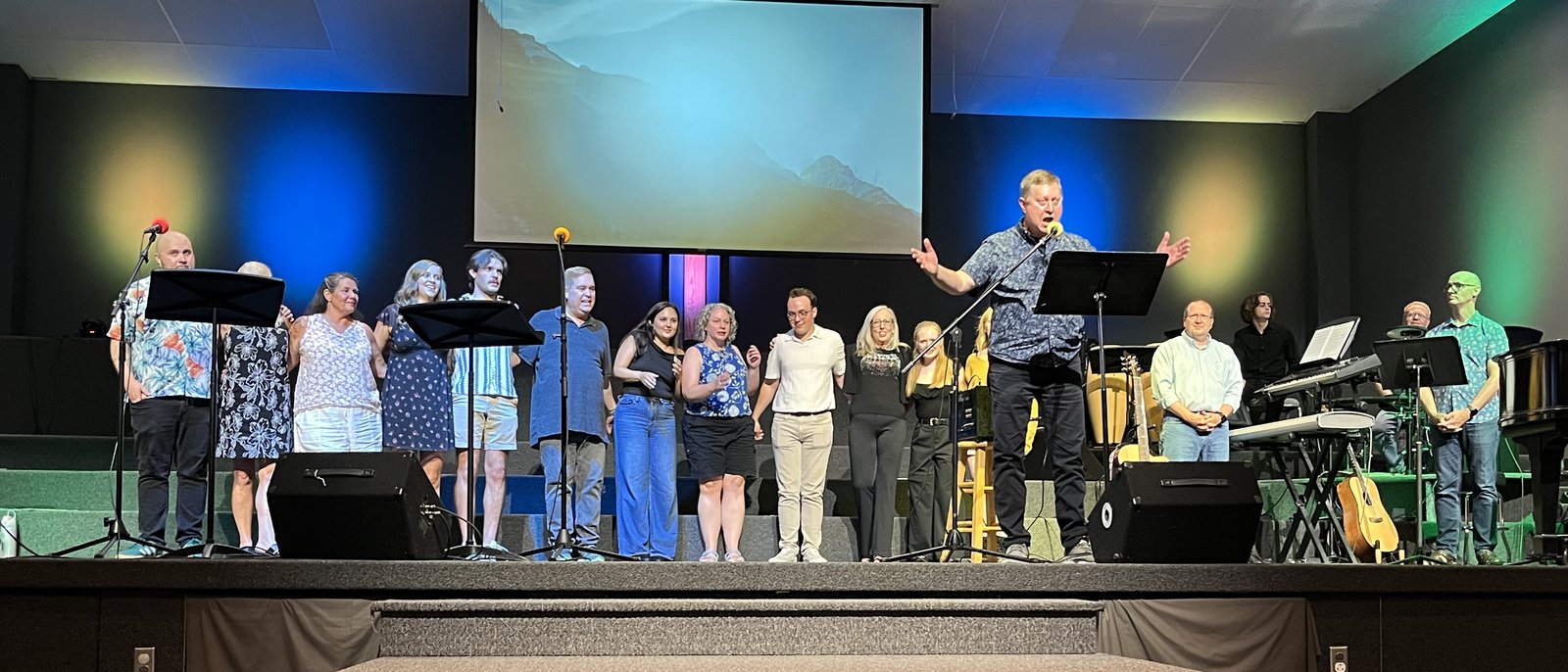
3) The legacy of the Agape Singers. The Agape Singers were more than a musical ensemble. They were a force for pushing the boundaries of how people might experience God in worship. They were inclusive and reconciling (small “r”) decades before Bethel became Reconciling (big “R”). They were a force for including children and youth in worship and mentoring young musicians. They often served in multiple areas of the church, including the youth program, children’s program, committees, Leadership Board, and the Chancel Choir. And they always sang to serve the message and not to serve their egos. They exist now only to sing for the 11:00 PM Christmas Eve service, having merged with the Chancel Choir in 2021 to become the Bethel Choir. But their legacy lives on in ways we might not even realize.

-
Bethel International UMC